



Guest blog: Reimagining Durham’s Paper Streets by Brenna Carpenter
Posted on January 5, 2026
As the Museum of Durham History looks toward a pivotal moment of growth and transformation, we are continually inspired by the creativity and care that our community brings to imagining Durham’s future. This year, as we reflect on what is possible at our site at 500 W. Main St., we are especially grateful for opportunities to see our home and surrounding community through fresh, visionary eyes.
The work you’re about to read, developed by NC State Master of Landscape Architecture & Environmental Planning student, Brenna Carpenter, does exactly that. Thoughtful, research-driven, and deeply grounded in Durham’s history and lived realities, this project reimagines the “paper street” beside MoDH as a living system: one that feeds people, tells stories, supports biodiversity, and invites care and connection across generations. Ms. Carpenter’s perspective builds on what we strive to do every day: use history as a living resource, rooted in real places and real people.
We are honored to share this work at a moment when MoDH itself is imagining new possibilities for our footprint and our role downtown. Designs like this remind us that the future of Durham is not only something to plan for, but something we can cultivate together by listening closely to the land, to history, and to one another. All images courtesy of Brenna Carpenter.
NC State’s Master of Landscape Architecture & Environmental Planning (LAEP) program in Raleigh is a hub where students design climate resilience and justice in the outdoor built environment. As a student in the program and a resident of Durham, I want my city to support life. We– humans, plants, birds, bugs, soil, water– are living beings, and our cities must support the systems of life to which we belong.
In fall 2025, LAEP students selected a paper street in Durham to reimagine. A “paper street” is an underutilized area the city recognizes as a street on paper but does not maintain. With more than 700 paper streets, Durham holds immense potential for rethinking public space. I worked with Great Jones paper street, the bollarded lane to the right of the Museum of Durham History (MoDH) entrance. After diving into Durham’s history and researching community-integrated public spaces across the U.S., I developed my project– Static to Dynamic: Learning Our Past. Feeding Our Future. Engaging Our Present.
Strengths and Site Overview
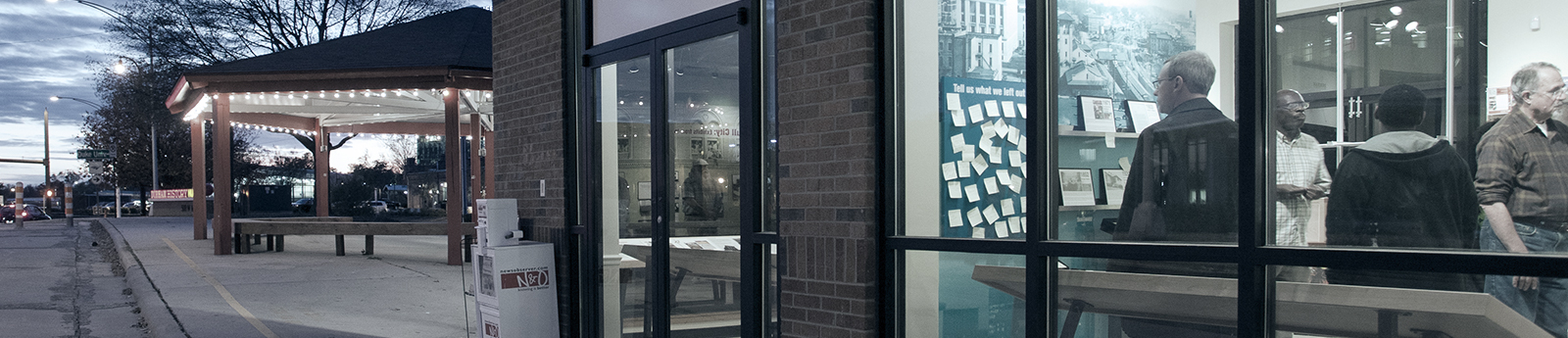
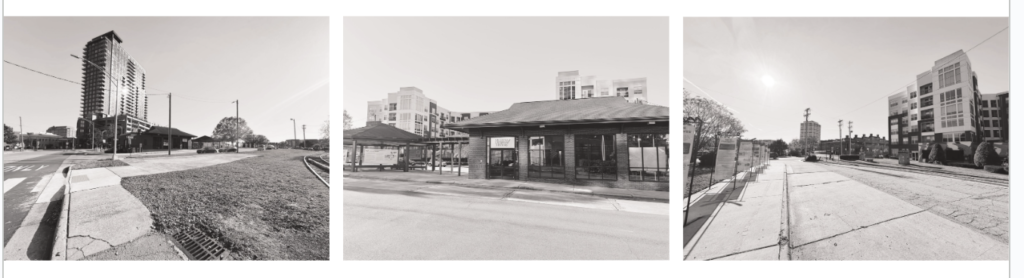
The MoDH occupies a former bus station on a large traffic island, so space is limited. Something I found special about this small space, though, is the intimate approach to the telling of Durham’s past with individual residents’ stories told in outdoor exhibits accessible at any hour. My design builds on that strength, claiming both lanes flanking the MoDH as an exhibit garden to land in and reflect. Another focus of my design is cultivating a relationship with land, especially in children, Durham’s future. The third and central design element is a food forest throughout, meaning plants of that exhibit garden are selected not only for beauty and shade, but for their capacity to feed us. This site is a template to be adapted across Durham’s paper streets, addressing present issues raised by long-time residents’ calls for balance as the city develops.
Existing Site
Aerial view and map of existing site
Social Context and Physical Assessment
During assessment of the site’s social context, one quote rang in my mind: “I don’t want to be a plaque.” Intergenerational Black residents– many made poor by past city policies– don’t want a fancy new installation about how they used to thrive here. “Durham needs to honor the historical contribution of African Americans in a… tangible way…” (Durham Comprehensive Plan p24). Residents call for healthy community that includes access to healthy food, a peppering of small green spaces, and accessible learning and play opportunities for their children. These priorities shaped a design rooted in living systems.
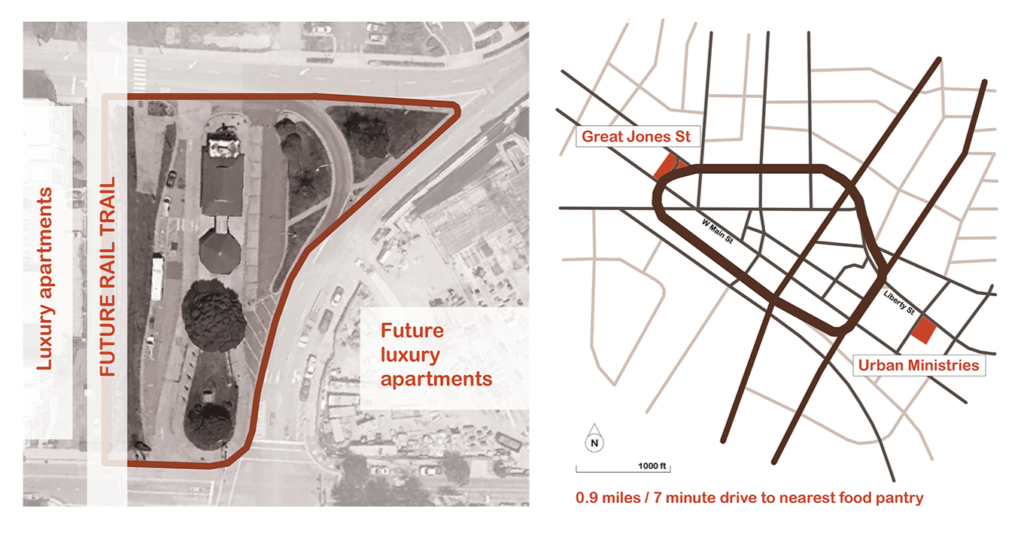
From the physical assessment, four key issues emerged. It’s exposed: to the sun above, radiating pavement below, and aggressive traffic noise on all sides. Second, there is nowhere to linger, digest, or allow the nervous system to recenter. Third is stormwater runoff as the site is 80% paved with concrete, asphalt, or turf grass which offers minimal infiltration. Lastly, biodiversity: other than a small bed at the back of the building, there are six plant species on the entire site, two of which are mildly invasive.
Monetary value
How It Works
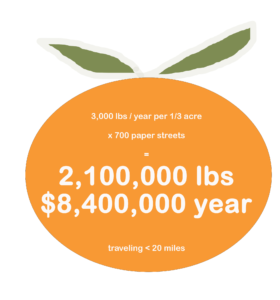
A food forest addresses these challenges while building on the site’s strengths by bringing food production back into residents’ lives on an intimate, accessible scale, offering food to any passerby who is hungry. One proven model allocates 60% of produce to a CSA to cover costs of farm managers, and 40% to food banks and underserved schools, who purchase produce from conglomerates sourcing from around the globe. Great Jones’ harvests go to Urban Ministries, less than a mile away. A conservative model of the early annual value of the 700 paper streets– while trees are small, for example, and programs are developing– predicts over 2,000,000lbs or over $8,000,000 of produce, traveling less than 20 miles. The true potential is many times greater. Field trips, after school programs, and high school clubs empower students, drawing inspiration from Urban Farm at Enston Home in Charlston. Volunteers– children and adults alike– provide much of the labor, fostering stewardship and community agency as the Washington Youth Garden does in DC.
The city benefits as well. As Durham becomes a more biophilic city, with pockets around every corner inviting exploration and exercise, it cultivates a healthier populace and that costs the city less (BiophilicCities.org). Urban greenery reduces public stormwater management costs. Early integration of green infrastructure, as demonstrated by Asheville-based landscape architecture firm, Living Roofs, Inc., can eliminate the need for conventional stormwater systems altogether, and surrounding luxury developments gain tax value from views of green space. This helps balance the economic growth of welcoming fresh newcomers with tending the deep roots of intergenerational residents, many POC, without which, Durham would become just another fragile turf of Anytown, USA.
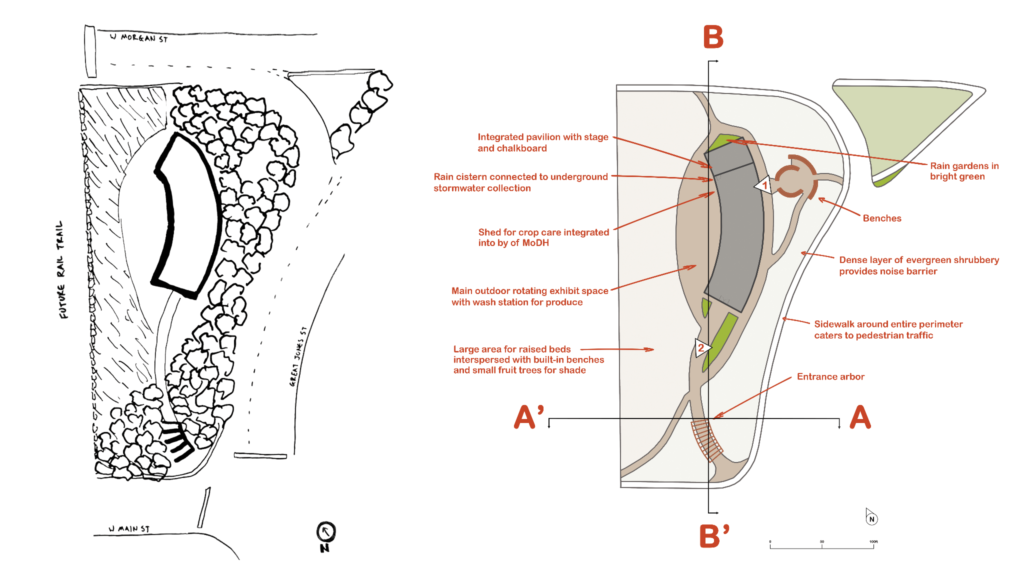
Greenscape and hardscape site plans
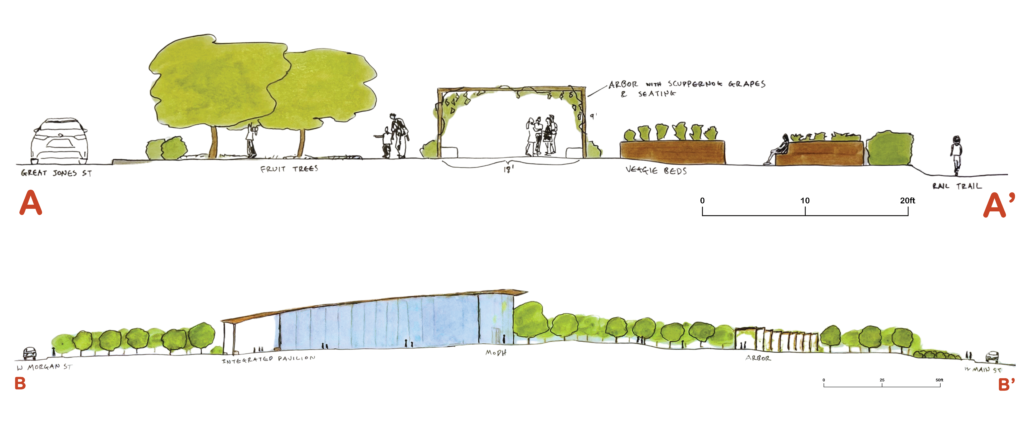
Cross sections AA and BB
Greenscape and Hardscape
Dense evergreen shrubs buffer traffic noise, while fruit trees– including native pawpaw and American persimmon alongside high-yield trees like apple– provide respite. Blueberry and raspberry bushes line forest edges, and native scuppernong grapes trace the entrance arbor. Crops prone to road contamination– like tomatoes and leafy greens– are in the interior, grown in remediated soil and raised beds inspired by Lentspace in Manhattan.
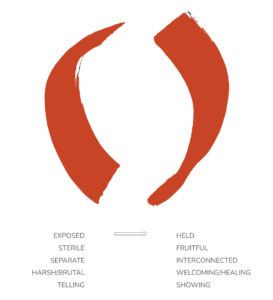
Parti diagram
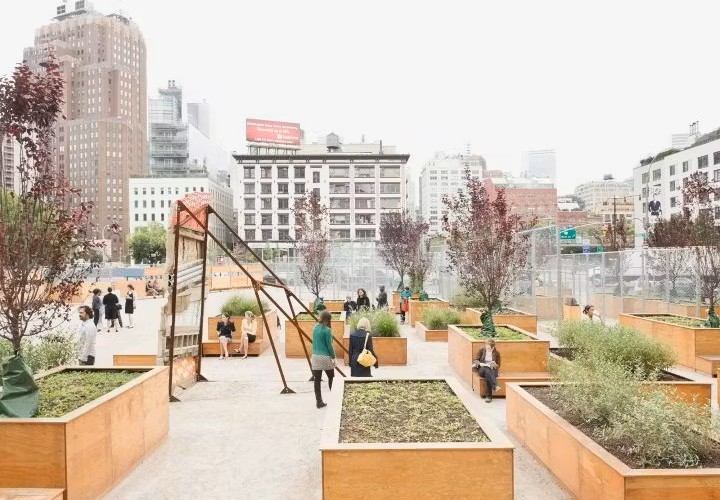
Lentspace project in Manhattan
The old bus station is succeeded by a structure that invites awe and engagement. The extended MoDH footprint includes a rear pavilion preserving the fundraising stage and adding a community chalkboard, wash station, and rain cistern. The roadside banners are integrated into the entrance arbor with shade and seating, so even for those popping into the site for a quick lunch break, there is opportunity to learn and experience in a way that keeps them coming back. Multi-use exhibit structures built by local artists transform into new configurations with each changing exhibit. 100% of the concrete is reused on-site as a permeable, ADA accessible mosaic, avoiding the carbon and monetary expense of hauling, as D.I.R.T. studio did in Philadelphia.
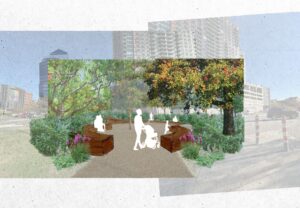
Perspective 1
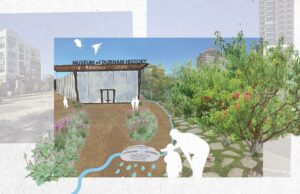
Perspective 2
A Living Future for Durham, A New Statement for MoDH
The whole of this design supports Durham’s 2050 goals of becoming a carbon-neutral, biodiverse community that balances preservation with sustainable development. It advances access to healthy food, addresses environmental racism, and prioritizes ecological restoration as essential to public health (Comp Plan p61).
History is our collective memory and it is alive. It is the sometimes invisible bones and connective tissue of our city. When we open our eyes to history and living systems everywhere, we can guide our shared future more consciously. In this vein, our exhibits are integrated everywhere into the park. In order to learn, we have to be fed and we need to feel safe. So take refuge here and when ready, give back to a place where you are already a member. Touch, experience, grow. This ain’t your grandparents’ don’t-touch museum.