


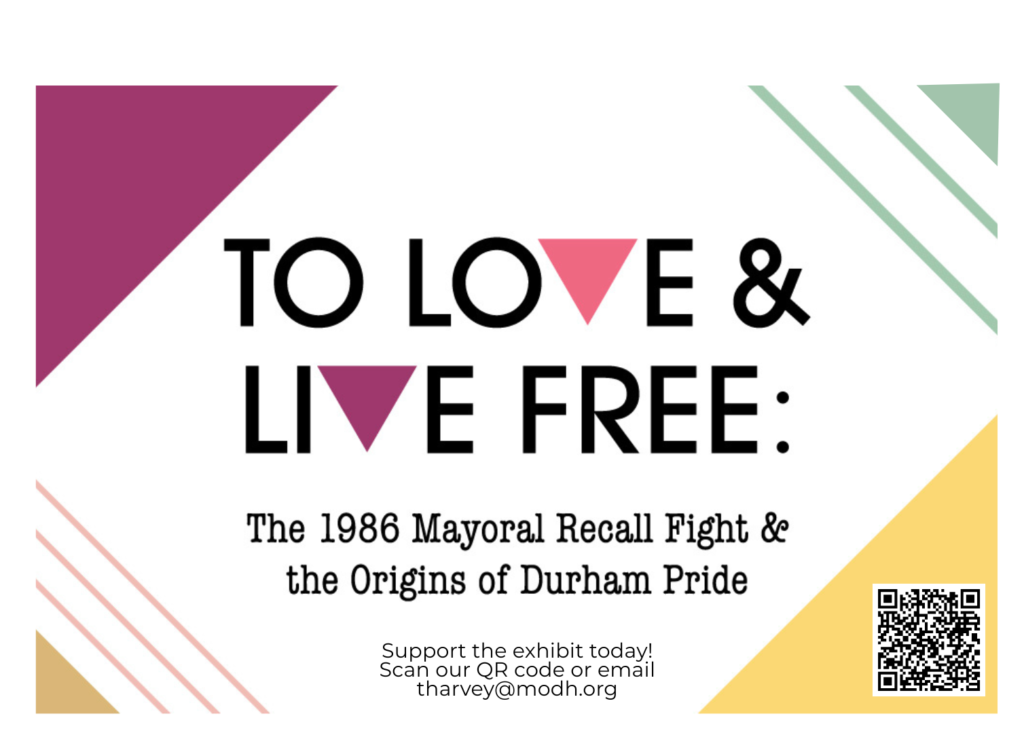
To Love and Live Free: The 1986 Mayoral Recall Fight and the Origins of Durham Pride
To Love and Live Free (showing May 15- October 11, 2026) commemorates the 40th anniversary of the “Out Today, Out To Stay” Pride march and the failed attempt to recall Mayor Wib Gulley in 1986 for his support of LGBTQ+ rights. It tells how Durham found itself at a crossroads between tolerance and bigotry, showing how today’s inclusive Durham emerged through organizing, protest, and moral courage from citizens, faith leaders, business owners, and activists who united for equal rights—and won.
In the summer of 1986, Durham faced a choice about what kind of city it wanted to be.
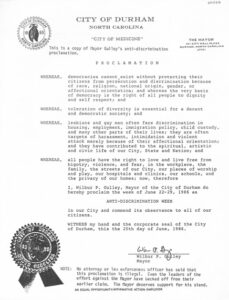
In June of that year, the newly-elected Mayor Wib Gulley signed a proclamation that specifically condemned discrimination against lesbians and gay men. Widely viewed as a statement of support for Durham’s LGBTQ+ community, the proclamation sparked an intense backlash, culminating in a campaign to recall Gulley for his stance on gay rights.
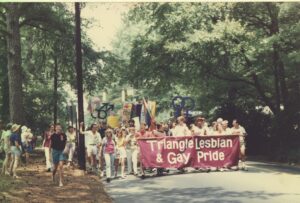
The typically sleepy Durham flared into a heated contest for weeks. On one side, a conservative establishment that viewed homosexuality as a threat to the moral fabric of the city. On the other, a progressive movement that viewed discrimination as a threat to human rights. The recall debate dominated the news, reaching into faith communities, neighborhoods, the public library, and the business community. The controversy swirled around a single question: was Durham a welcoming place to be gay?
To Love and Live Free tells the story of this controversy and the events that led up to it. Beginning with North Carolina’s first march for lesbian and gay rights in 1981, this exhibit asks: What does it take to change a city? In the early 1980s, a group of everyday people came together to answer that question.
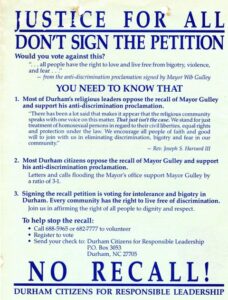
Many of those who led the 1986 campaign to save Gulley’s mayorship had been organizing for years around issues of racial justice, economic opportunity, anti-violence, and LGBTQ+ rights. They used the relationships they had built and strategies they had learned to advocate for a more inclusive Durham. They also brought new people into the movement as they mobilized a diverse group of civic leaders to more boldly articulate their commitments to equal rights for all.
In doing so, they showed democracy at work.
To Love and Live Free uses archival materials from the North Carolina Collection at the Durham County Library, including eighteen new oral histories recorded for this exhibit. We invite you to explore this history through the voices of those who worked together to make it happen—and consider their lasting impact on Durham.
Listen to the audio clips in the exhibit (parts of some in the video below) to hear memories of political organizing in Durham in the 1970s and early 1980s.
A Note on Language:
Though what we now think of as the LGBTQ+ movement includes a broad spectrum of identities and experiences, in the mid-1980s public discourse referred primarily to the “lesbian and gay rights movement” or often just “gay rights.” This exhibit uses these terms to illustrate how people self-identified and talked about these issues at the time. For clarity, the exhibit uses “LGBTQ+” to refer to contemporary understandings of sexual and gender identity. Archival records often use language that omits or erases transgender and other queer people; these absences do not mean such experiences were not present or active. We encourage visitors to consider both the language used and the voices that may be missing from the archives.
Photo Credits: North Carolina Collection, Durham County Library
Thank you to our sponsors:
 |
In addition to our sponsors, this exhibit is supported by the Durham Arts Council’s Annual Arts Fund and the N.C. Arts Council, a division of the Department of Natural & Cultural Resources. |